Scientific article · Sources checked 2026-10-21 · Source dates below
A 12-Week Acne Trial Found Close Lesion Reductions With Two Different Formulas
A 37-person comparison of a chloroxylenol–salicylic acid cream and benzoyl peroxide gel offers useful acne findings—but its percentages describe lesion counts, not the share of people cleared.
Public-source editorial review. No clinician sign-off, firsthand product testing or personal assessment claimed.
A small randomized acne trial reported strikingly close results: inflammatory lesions fell by 60% with benzoyl peroxide gel and 62% with a cream containing chloroxylenol plus salicylic acid. Those figures are worth understanding before they become a claim about a cream. They describe reported reductions in lesion counts after 12 weeks, not treatment-success rates among participants, and the comparison tested two complete formulations rather than salicylic acid by itself.
The useful question is therefore narrower than whether salicylic acid matches benzoyl peroxide. What did this particular combination achieve, against which comparator, over what period, and with what uncertainty? This analysis uses the indexed primary report abstracts for three clinical studies and available official FDA material. It does not assume access to the studies’ complete protocols, supplements, or full statistical analyses.
In this reading
Study facts at a glance
Study population and duration: Thirty-seven volunteers participated in a randomized, double-blind, 12-week comparison: 19 received benzoyl peroxide gel and 18 received the combination cream. Source 1
Exact treatments: The trial compared topical benzoyl peroxide 5% gel with chloroxylenol 0.5% plus salicylic acid 2% cream, not salicylic acid alone. Source 1
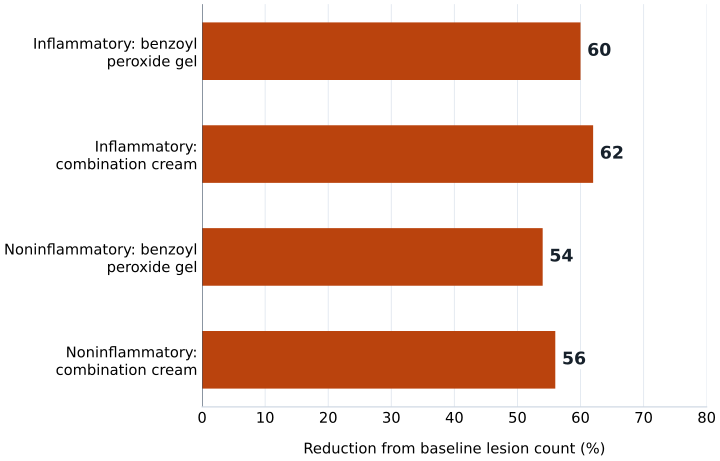
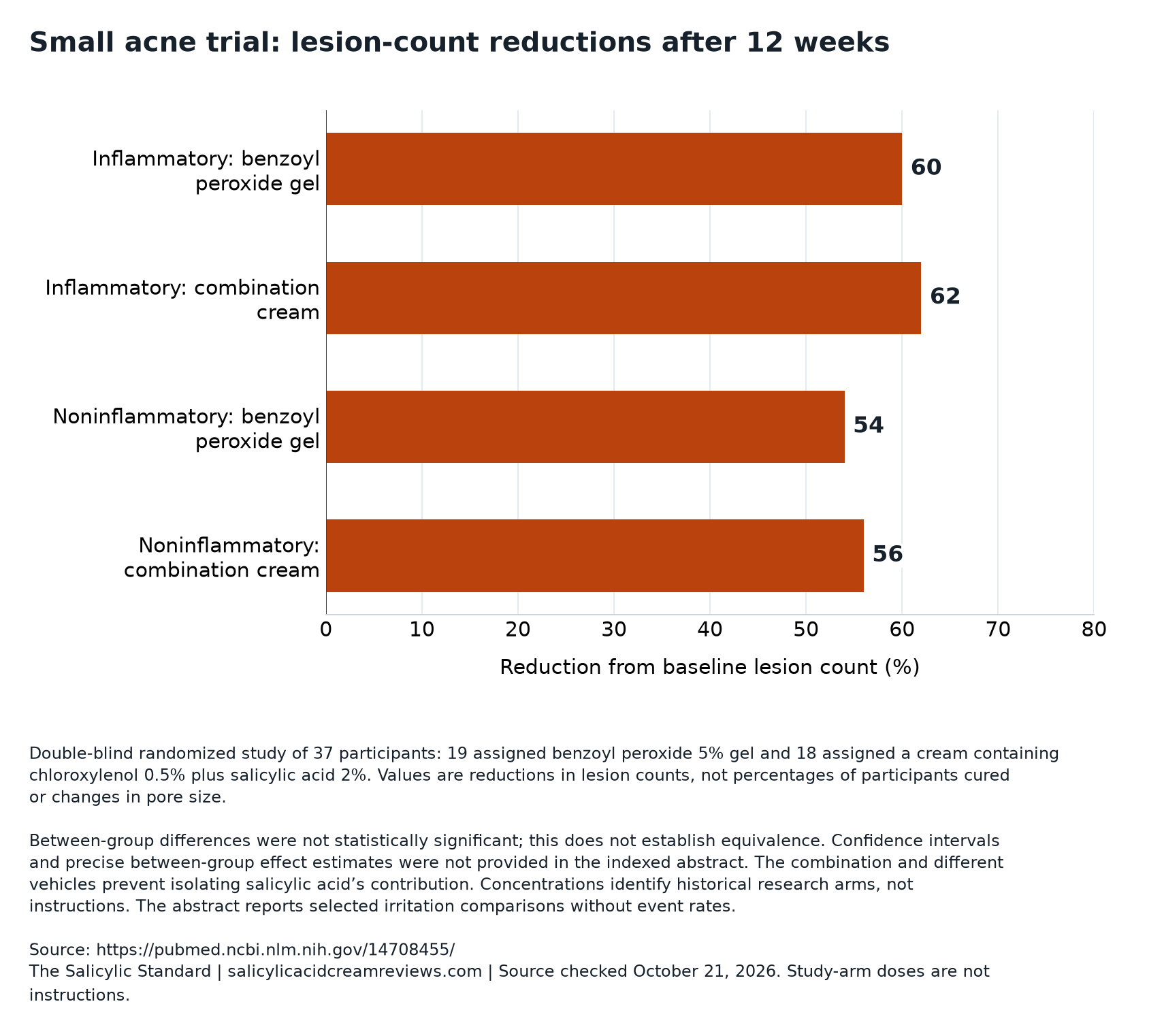
Reported lesion reductions: At week 12, inflammatory lesion reductions were 60% versus 62%, and noninflammatory lesion reductions were 54% versus 56%, for benzoyl peroxide and combination cream, respectively. Source 1
Statistical interpretation: The abstract reports no statistically significant between-group difference in lesion reductions; it does not establish formal equivalence or supply confidence intervals. Source 1
Tolerability signal: Erythema and photosensitivity were reported as significantly less frequent with the combination at week 12, but event counts and absolute risk differences are unavailable in the abstract. Source 1
The experiment compared complete topical treatments
The central study assigned 19 volunteers to benzoyl peroxide 5% gel and 18 to a cream containing chloroxylenol 0.5% and salicylic acid 2%. Participants applied their assigned topical medication to the entire face twice daily for 12 weeks. These details identify the research arms; they are not a suggested regimen for another product or person.
Investigators performed clinical evaluations and lesion counts at baseline and weeks 3, 6, 9, and 12. The report describes the study as randomized and double-blind. Random assignment helps limit systematic differences between groups, while blinding aims to reduce expectations influencing treatment experience or assessment. The abstract does not explain how assignment was concealed or how the cream and gel were masked.
The accessible report does not identify a prespecified primary endpoint or provide enough information to reconstruct the full analysis plan. It also does not specify participant ages, detailed baseline severity, sponsorship, or funding. Those gaps limit how confidently the results can be applied to a particular acne population.
Read the underlying chart data: download CSV or download the source-labeled chart.
The percentages measure lesions, not people cleared
The week-12 findings separate inflammatory lesions from noninflammatory lesions. Papules and pustules are inflamed bumps, sometimes containing pus; comedones are plugged follicles commonly described as blackheads and whiteheads. Keeping these categories separate matters because a treatment can affect them differently.
The abstract reports group-level inflammatory lesion reductions of 60% for benzoyl peroxide and 62% for the combination. Noninflammatory reductions were 54% and 56%, respectively. It does not specify whether these percentages summarize individual percentage changes or changes in aggregated counts, so they should not be labeled means or medians.
For illustration only, a 60% reduction from a baseline count of 50 lesions would leave 20; a 62% reduction would leave 19. That arithmetic explains a count reduction, not what any participant experienced. Neither percentage says that 60% or 62% of volunteers became clear, and neither provides a clearance rate.
Reported week-12 lesion-count reductions in the 37-person trial
| Outcome | Benzoyl peroxide 5% gel | Chloroxylenol 0.5% plus salicylic acid 2% cream |
|---|---|---|
| Inflammatory lesions | 60% reduction | 62% reduction |
| Noninflammatory lesions | 54% reduction | 56% reduction |
| Participants assigned | 19 | 18 |
| Between-group lesion comparison | No statistically significant difference reported | No statistically significant difference reported |
Close results do not establish equivalence
For each lesion category, the reported reduction favored the combination by 2 percentage points. That is the difference between two percentages, not a two-percent reduction in a person’s chance of acne. It is also not a risk ratio: the outcome here concerns lesion counts rather than the probability of a defined event.
The investigators found no statistically significant between-group difference in reductions of papulopustules or comedones. This means the reported analysis did not establish a difference under its statistical criteria. It does not demonstrate that the treatments are interchangeable. Small samples can produce imprecise comparisons even when their point estimates look close.
Formal equivalence requires a defined acceptable difference and an analysis showing that uncertainty falls within that boundary. The abstract supplies neither an equivalence margin nor confidence intervals. Although its conclusion describes comparable effectiveness, the defensible reading is that this small trial observed similar reductions without resolving how large the true difference might be.
Salicylic acid was not the only difference
The combination arm contained chloroxylenol as well as salicylic acid, and its vehicle—the base carrying the ingredients—was a cream rather than a gel. Consequently, the study estimates the performance of one complete treatment against another. It cannot divide the observed improvement among salicylic acid, chloroxylenol, their interaction, and the formulation base.
There was no salicylic-acid-only arm, chloroxylenol-only arm, or otherwise matched cream without those ingredients in the reported comparison. Without such controls, assigning the entire result to the 2% salicylic acid would go beyond the experiment. The abstract’s description of slightly stronger keratolytic activity, meaning an effect on shedding surface skin cells, does not solve that attribution problem.
This is why comparing two products labeled 2% salicylic acid requires more than matching the concentration. The trial does not establish equivalent results for a cleanser, serum, compounded preparation, or another cream. Route, vehicle, co-ingredients, exposure, and product identity remain part of the evidence.
The irritation findings lack an absolute-risk denominator
At week 12, the combination group had significantly fewer reports of erythema, or redness, and photosensitivity than the benzoyl peroxide group. The abstract gives P values of 0.0002 and 0.05, respectively. These are genuine tolerability findings, but the accessible report does not provide the number of affected participants or the severity distribution.
A P value is not the percentage of people who had an adverse effect. In particular, 0.0002 cannot be translated into a 0.02% irritation rate. Without event counts and relevant denominators, readers cannot calculate the absolute difference in side-effect frequency or determine how many additional people experienced a reaction with either treatment.
The finding is also time-specific: it describes the reported week-12 comparison, not necessarily the cumulative experience across all 12 weeks. Missing detail on withdrawals, earlier reactions, and event ascertainment prevents a complete burden-of-treatment comparison. Better reported tolerability for this cream should not become a blanket claim that salicylic acid is gentler in every formulation.
A separate addition trial asked a different question
Another randomized study enrolled 49 patients with mild to moderate facial acne in a 12-week, prospective, single-blind comparison. It tested adding salicylic acid to clindamycin plus benzoyl peroxide against clindamycin plus benzoyl peroxide without that addition. Unlike the 37-person comparison, its question concerned an added treatment within an antibiotic-containing regimen.
The addition group had statistically greater reductions in inflammatory and total lesion counts throughout the reported study weeks, and in noninflammatory counts beyond two weeks. End-of-study global improvement ratings by patients and investigators also favored the addition. However, the abstract supplies no numerical effect sizes, confidence intervals, or salicylic acid concentration, preventing a useful calculation of the size of the added benefit.
Tolerability moved in a different direction: mild to moderate transient dryness was significantly more frequent with added salicylic acid. Both regimens significantly reduced stratum corneum hydration, a measurement of water in the outer skin layer. Thus, this study supports investigating an incremental benefit, but not a universal better-tolerance claim or instructions to assemble an antibiotic-containing regimen.
A split-face pilot cannot serve as a replication
A third randomized study used a different design: opposite sides of each participant’s face received different treatments for 28 days. Thirty-one participants completed this open-label, single-center trial of modified 2% supramolecular salicylic acid cream against benzoyl peroxide plus adapalene gel. Those are 31 completers, not 62 independent patients; enrollment and attrition details are unavailable in the abstract.
The comparator’s adapalene concentration is internally inconsistent in the indexed abstract: the title and methods specify 0.1%, while the objectives also state 0.01%. The benzoyl peroxide concentration is 5%. This discrepancy should remain visible rather than be silently corrected; the full article was not available for independent confirmation.
Reported inflammatory reductions were 47.9% versus 49.8%, noninflammatory reductions 43.1% versus 42.7%, and total reductions 44.1% versus 45.6%. Between-side comparisons were nonsignificant, not proof of equivalence. The separate split-face study analysis explores its skin measurements, whose nonsignificant between-side differences do not mean values stayed unchanged over time.
Three studies, three distinct treatment questions
| Study | Comparison and duration | Main interpretive boundary |
|---|---|---|
| 37 volunteers; randomized, double-blind | Chloroxylenol–salicylic acid cream versus benzoyl peroxide gel; 12 weeks | Cannot isolate salicylic acid or establish equivalence |
| 49 enrolled; randomized, single-blind | Salicylic acid added to clindamycin–benzoyl peroxide versus the base regimen; 12 weeks | Benefit magnitude unavailable; more transient dryness |
| 31 completers; randomized, open-label split-face | Modified salicylic acid cream versus benzoyl peroxide–adapalene gel; 28 days | Different formulation, paired design, short follow-up, and comparator concentration discrepancy |
Twelve-week lesion counts leave longer-term questions open
Scheduled visits at three-week intervals provide repeated observation during treatment, but the accessible main-trial abstract primarily quantifies the week-12 outcome. It does not provide enough intermediate counts to calculate onset, response trajectories, or when one treatment might have separated from the other. The endpoint result should not be converted into a promise about improvement within days.
Nor does the report establish durability after treatment ends, recurrence, prevention of scars, or lasting changes in visible pore size. Reducing comedones is an acne outcome; it is not direct evidence that pores permanently shrink. The FDA acne monograph addresses acne lesions, blackheads, and whiteheads rather than establishing permanent pore-size change.
An informative follow-up trial would use a larger sample, clearly identified primary outcomes, confidence intervals, complete adverse-event counts, and a formulation-matched design if ingredient attribution were the goal. Longer observation could then address persistence and delayed effects. These are unresolved research questions, not outcomes already demonstrated by the existing comparison.
FDA ingredient conditions are separate from product approval
FDA’s topical acne monograph lists salicylic acid at 0.5–2% and benzoyl peroxide at 2.5–10%. Those ranges sit within a broader set of applicable conditions; concentration alone does not establish conformity. The monograph is neither a clinical trial nor product-specific FDA approval, and it does not validate the exact combination studied here.
Drug and cosmetic contexts also differ. FDA’s beta hydroxy acid background page discusses salicylic acid in cosmetics and exfoliation, but that discussion does not establish a precise acne, wrinkle, or pore-size benefit for every cosmetic. Its account of an older industry safety assessment should not be presented as a new clinical trial or a current product endorsement.
The practical distinction is documentary: identify the exact product, its current label, and the claim being evaluated. The guides to compounded versus retail salicylic creams and product-version and label records organize those questions without treating a shared ingredient name as proof that products share trial outcomes.
Safety signals and commercial claims need different evidence
FDA distinguishes ordinary local irritation from rare serious hypersensitivity reported with some acne products containing salicylic acid or benzoyl peroxide. The responsible ingredient was not established; active ingredients, inactive ingredients, or both could be involved. Throat tightness, breathing difficulty, faintness, or swelling of the eyes, face, lips, or tongue warrant stopping the product and seeking emergency care.
The historical FDA review identified 131 reports through January 28, 2013, including 58 hospitalizations and 50 categorized as anaphylactic. These selected reports have no user-exposure denominator and cannot yield an incidence rate. Similarly, a small-area sensitivity check cannot guarantee that a later allergic reaction will not occur. This safety evidence answers a different question from average lesion improvement.
Editorial interpretation: a favorable trial result cannot validate a subscription’s value, renewal terms, or clinical service. Readers considering an offer can use the CoreAge Rx review or Likeness Rx review to check documentary terms, without inferring either service supplies the studied formulation or outcomes. A year-plan cost review likewise concerns a contract, not evidence for a year of treatment.
Questions about the evidence
Does the 62% result mean 62% of participants cleared their acne?
No. It is a reported group-level reduction in inflammatory lesion counts after 12 weeks. Clearance would require a separate definition and a count of participants meeting it. The abstract does not provide that endpoint, and multiplying 18 participants by 62% would not recover a valid number of treatment successes.
Did the combination cream outperform benzoyl peroxide?
Its reported lesion reductions were numerically higher by 2 percentage points in both categories, but the between-group differences were not statistically significant. The abstract also reports fewer redness and photosensitivity events at week 12. That supports a limited tolerability signal, not established superiority across effectiveness and safety outcomes.
Why not treat the 49-person study as confirmation?
It tested a different question: adding salicylic acid to clindamycin plus benzoyl peroxide. It did not repeat the chloroxylenol–salicylic acid cream comparison. Its favorable lesion-count findings and increased transient dryness add context, but the missing effect sizes and formulation details prevent a direct numerical synthesis with the 37-person trial.
Would a 2% salicylic acid cleanser reproduce the cream results?
The evidence does not establish that. The main study used a leave-on combination cream with chloroxylenol, while the split-face pilot used a modified supramolecular preparation. Matching the salicylic acid percentage does not match the complete formulation, contact pattern, comparator, or study duration. Neither trial directly tested an ordinary cleanser.
Does an OTC acne monograph listing eliminate safety concerns?
No. Monograph conditions are not product-specific approval or a guarantee against irritation or allergy. FDA labeling warns that combining topical acne medicines can increase dryness and irritation. Its separate hypersensitivity communication describes rare serious reactions, while acknowledging uncertainty about which ingredients caused them and providing no incidence denominator.
What this evidence supports
The 37-person randomized comparison provides preliminary evidence that one chloroxylenol–salicylic acid cream and one benzoyl peroxide gel produced close reported lesion-count reductions over 12 weeks, with a week-12 tolerability advantage for the cream on two reported measures. It does not isolate salicylic acid’s contribution, establish formal equivalence, or quantify absolute side-effect differences. The strongest reading preserves the complete formulation, lesion-count denominator, comparator, and duration. Related trials broaden the scientific context but answer different questions; they do not turn this result into a class-wide promise for products bearing the same percentage.
Research access and limitations
Clinical interpretation is based on indexed primary study abstracts, not complete trial reports or supplements, alongside the available official FDA documents. Confidence intervals, detailed analysis methods, sponsorship, and several participant and adverse-event details were unavailable in the accessed abstracts.
Source records
- Comparison of chloroxylenol 0.5% plus salicylic acid 2% cream and benzoyl peroxide 5% gel in the treatment of acne vulgaris: a randomized double-blind study. ↗Indexed primary study abstract · Accessed 2026-10-21
- Efficacy of the addition of salicylic acid to clindamycin and benzoyl peroxide combination for acne vulgaris. ↗Indexed primary study abstract · Accessed 2026-10-21
- Efficacy and safety of 2% supramolecular salicylic acid compared with 5% benzoyl peroxide/0.1% adapalene in the acne treatment: a randomized, split-face, open-label, single-center study. ↗Indexed primary study abstract · Accessed 2026-10-21
- FDA OTC monograph M006: topical acne drug products ↗Official six-page administrative order, all sections read · Accessed 2026-10-21
- FDA: beta hydroxy acids in cosmetics ↗Official FDA consumer background page, complete text read · Accessed 2026-10-21
- FDA safety communication: serious hypersensitivity to some OTC acne products ↗Official FDA Spanish communication; entire safety notice and data summary read · Accessed 2026-10-21