Scientific article · Sources checked 2026-10-21 · Source dates below
Salicylic Acid’s 44.1% Lesion Reduction: The Comparator Behind a Four-Week Result
A randomized split-face pilot followed 31 completers using two different acne treatments. Its percentages describe short-term lesion-count changes—not clearance rates, proven equivalence, or permanent pore shrinkage.
Public-source editorial review. No clinician sign-off, firsthand product testing or personal assessment claimed.
A percentage can sound more decisive than the study behind it. In a 28-day acne trial, the reported total lesion-count reduction was 44.1% on facial sides treated with 2% supramolecular salicylic acid and 45.6% on sides treated with benzoyl peroxide plus adapalene. Those closely spaced numbers are useful preliminary evidence, but their meaning depends on the denominator, the paired design, the formulation, and what the investigators actually measured.
The study had 31 completers, not 62 independent patients. Each person contributed two treated facial sides, allowing a comparison within the same individual. This analysis uses the indexed primary report abstract and available official FDA material, alongside abstracts of two related trials; it does not claim access to the split-face study’s full methods or supplements. The central question is how much a short, small comparison can establish—and which cream or pore claims remain outside its reach.
In this reading
Study facts at a glance
Population and duration: Thirty-one people with mild to moderate acne completed a 28-day, randomized, open-label, single-center split-face trial; the starting enrollment denominator is unavailable in the abstract. Source 1
Treatments compared: One facial side received topical 2% supramolecular salicylic acid cream; the other received 5% benzoyl peroxide plus adapalene gel. The title and methods specify 0.1% adapalene, while the objectives also contain 0.01%. Source 1
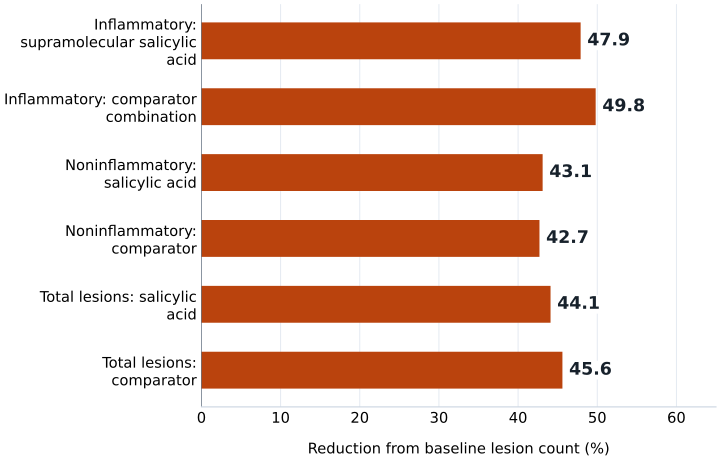
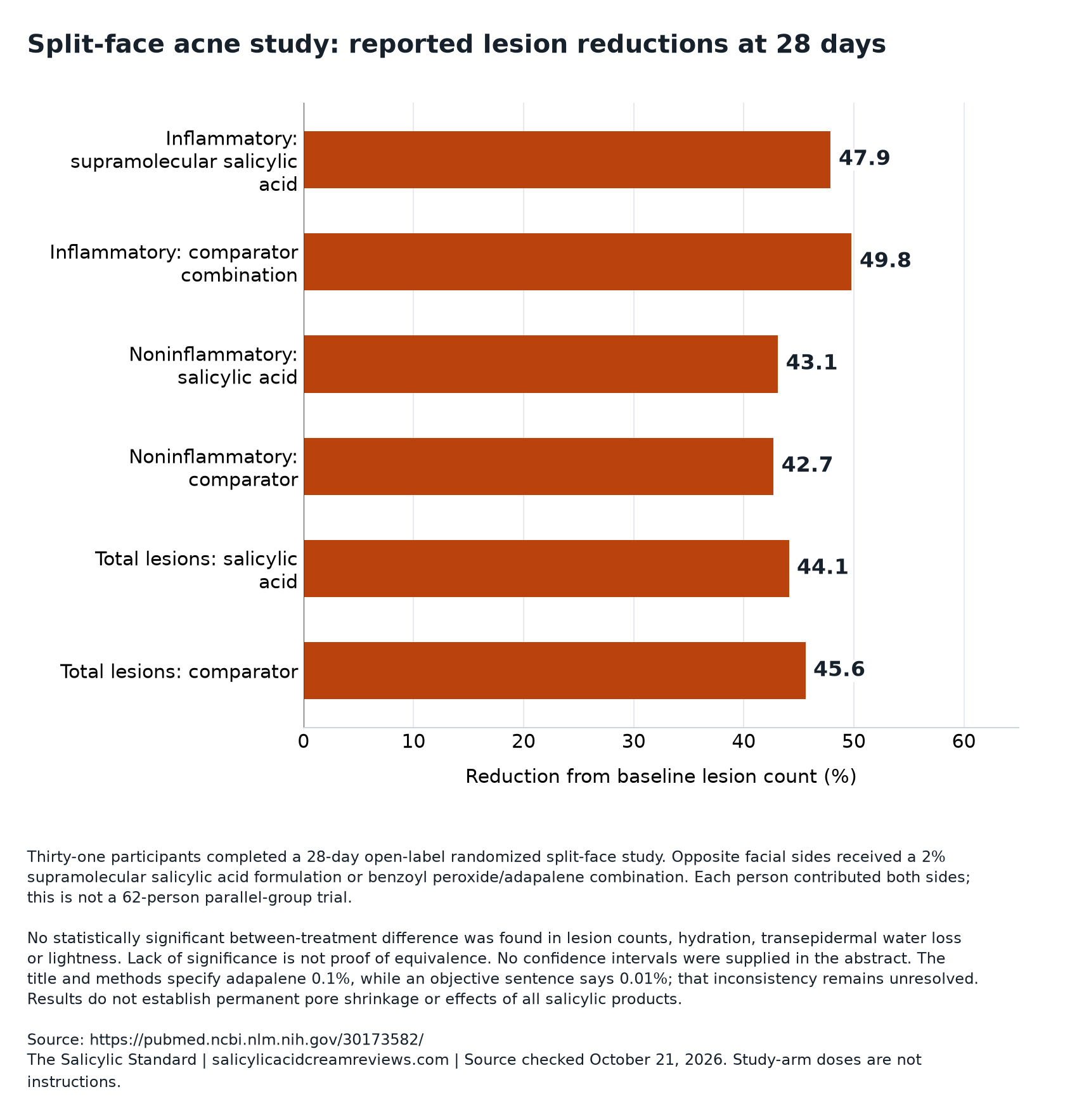
Total lesion-count result: Reported day-28 reductions were 44.1% with the salicylic acid formulation and 45.6% with the comparator. The between-side comparison was not statistically significant. Source 1
Skin measurements: The abstract reports no statistically significant between-side differences in hydration, transepidermal water loss, lightness, or erythema; that is not proof that values never changed or irritation never occurred. Source 1
Regulatory boundary: FDA’s OTC acne monograph lists salicylic acid at 0.5–2%, but concentration alone does not establish monograph conformity, product-specific approval, or permanent pore-size effects. Source 6
Two facial sides still represent one participant
The investigators enrolled people with mild to moderate facial acne and randomly assigned 2% supramolecular salicylic acid cream to one side of the face. The opposite side received a gel containing benzoyl peroxide and adapalene. Both were topical treatments, applied over the same 28-day observation period. Investigators assessed lesions and side effects at baseline, day 14, and day 28.
This paired design helps control person-level differences: the two treatments share the participant’s age, general environment, and many other characteristics. But the observations are linked. Counting 31 people twice does not create a 62-person independent trial. Statistical analysis needs to respect that pairing; the indexed abstract does not provide enough detail to inspect how the paired data were modeled.
Random assignment is a genuine strength, but the trial was open-label, meaning treatment assignment was not concealed through blinding. That leaves room for expectations to influence assessment or behavior, without establishing that such bias actually occurred. A single-center study also offers less information about reproducibility across settings than a coordinated multicenter investigation.
Read the underlying chart data: download CSV or download the source-labeled chart.
The formulation matters as much as the percentage
The experimental cream contained supramolecular salicylic acid, described in the abstract as a modified salicylic acid preparation. It was not simply an unspecified retail product carrying a 2% label. The comparator was also more than benzoyl peroxide alone: it combined 5% benzoyl peroxide with adapalene. These concentrations identify the research treatments, not a regimen for readers to reproduce.
There is an important reporting inconsistency. The study title and methods identify 0.1% adapalene, while the objectives contain both a 0.01% reference and a parenthetical reference to 0.1%. The most defensible account attributes 0.1% to the title and methods while explicitly retaining the discrepancy. Without the full report, it cannot be independently resolved.
Because the study compared a modified cream with a combination gel, any observed difference—or lack of a detected difference—belongs to those treatment packages. It cannot isolate the contribution of salicylic acid chemistry from the vehicle. The guide to comparing two products labeled 2% salicylic acid provides a useful framework for keeping concentration, formulation, and product identity separate.
What the lesion percentages actually describe
At day 28, the abstract reports reductions in three lesion categories. Inflammatory lesions were papules and pustules; noninflammatory lesions were counted separately, and total lesions combined the categories. These are lesion-count outcomes, not percentages of patients whose acne cleared. The abstract does not identify a single prespecified primary endpoint, so none should be retroactively designated.
The table preserves the order of the reported comparison: supramolecular salicylic acid first, benzoyl peroxide plus adapalene second. It also shows simple percentage-point subtraction. That arithmetic describes the distance between reported reductions; it is not an additional statistical analysis or an estimate of how many people benefited.
The abstract does not specify whether these percentages summarize individual percentage changes or were calculated another way. They should therefore be called reported group-level reductions, not means or medians. Baseline lesion totals are also unavailable, preventing a reconstruction of how many lesions the percentages represent.
Reported lesion-count reductions at day 28; percentage-point differences are salicylic acid minus comparator.
| Lesion category | Reported reduction: salicylic acid / comparator | Difference and statistical context |
|---|---|---|
| Inflammatory lesions | 47.9% / 49.8% | −1.9 percentage points; between-side comparison not significant |
| Noninflammatory lesions | 43.1% / 42.7% | +0.4 percentage points; between-side comparison not significant |
| Total lesions | 44.1% / 45.6% | −1.5 percentage points; between-side comparison not significant |
A reduction in counts is not a clearance rate
Consider a purely illustrative facial side with 100 lesions at baseline. A 44.1% reduction would correspond to a calculated reduction of 44.1 lesions and 55.9 remaining. Fractional lesions make clear that this is an arithmetic illustration, not an actual participant’s record. It does not mean that 44.1 out of every 100 participants became clear.
Starting counts matter just as much as the percentage. A hypothetical reduction from 50 lesions to 28 is 44%, while a reduction from 25 to 14 is also 44%. The relative improvement matches, but the absolute reduction differs. Without baseline and follow-up counts, the abstract cannot support a reliable translation of its percentages into lesions removed per person.
Nor can total lesion improvement answer every clinical question. The study separately reports inflammatory and noninflammatory outcomes, which is more informative than relying on the total alone. Still, the abstract does not provide patient clearance rates, scar outcomes, or a quantified patient-perceived benefit. A count can capture a meaningful change without capturing the entire experience of acne.
Close results do not establish equivalence
All three day-28 lesion comparisons were reported as statistically nonsignificant. That means the reported analyses did not establish a between-side difference under their statistical criteria. It does not mean the treatments have been proven identical, or that a clinically important difference has been ruled out.
Formal equivalence requires a different evidentiary framework: a justified margin defining how much difference is acceptable and sufficiently precise estimates relative to that margin. The accessible abstract supplies no such margin and no confidence intervals. Confidence intervals would show the range of differences compatible with the data under the statistical model, which matters especially in a small pilot.
The point estimates are close, making further investigation reasonable. The unresolved issue is precision: how large a true advantage or disadvantage might still fit these observations? The authors describe the work as a pilot supporting larger trials. That is a stronger foundation for follow-up research than for a categorical claim that salicylic acid replaces the comparator in all circumstances.
Skin measurements answer narrower questions than pore claims
Investigators measured skin water content, transepidermal water loss, lightness, and erythema. Transepidermal water loss, often abbreviated TEWL, measures water escaping through the skin and is used to assess aspects of barrier function. The L* measurement concerns lightness, while a* relates to redness. These instruments address different properties rather than a single overall measure of skin health.
The abstract reports no statistically significant between-side differences in these indicators. That is a comparison between treatments, not proof that either side remained unchanged from baseline. Both could change similarly, or the study could lack precision to distinguish their changes. The abstract does not provide the numerical measurements needed to resolve those possibilities.
None of these outcomes directly establishes permanent pore shrinkage. Lesion counts, lightness, redness, and water loss are not interchangeable with visible pore dimensions or lasting structural change. FDA’s BHA background page discusses cosmetic exfoliation but does not establish a precise pore-size benefit. The salicylic-acid creams and alternatives guide can help organize product records without converting acne endpoints into cosmetic promises.
Other salicylic trials tested different treatment questions
Two related randomized studies add context but do not replicate the split-face experiment. A 12-week double-blind trial compared a cream containing chloroxylenol plus salicylic acid with benzoyl peroxide gel. Another 12-week, single-blind trial tested whether adding salicylic acid improved a clindamycin–benzoyl peroxide regimen. Neither isolates the same modified salicylic acid cream used in the 28-day trial.
The combination-cream study reported numerically similar lesion reductions without significant between-group differences. The add-on study favored the salicylic-acid-containing regimen for several lesion outcomes, but its abstract does not provide effect sizes or confidence intervals. These findings cannot be ranked as though participants, comparators, duration, and formulations were interchangeable.
The companion analysis of the salicylic acid combination-cream trial examines why an ingredient combination cannot establish salicylic acid’s independent effect. Across these reports, the useful question is not which headline percentage is largest. It is which treatment comparison each experiment was designed to answer.
Three randomized trials with different populations, comparators, and interpretations.
| Study design and size | Treatment comparison | Reported finding and boundary |
|---|---|---|
| 28-day open-label split-face trial; 31 completers | 2% supramolecular salicylic acid cream versus 5% benzoyl peroxide plus adapalene gel | Total lesion reductions 44.1% versus 45.6%; nonsignificant comparison does not establish equivalence |
| 12-week double-blind trial; 37 volunteers, 19 benzoyl peroxide and 18 combination cream | 0.5% chloroxylenol plus 2% salicylic acid cream versus 5% benzoyl peroxide gel | Inflammatory reductions 62% versus 60%; noninflammatory reductions 56% versus 54%; no significant lesion-reduction difference |
| 12-week single-blind trial; 49 enrolled | Salicylic acid added to clindamycin plus benzoyl peroxide versus the regimen without added salicylic acid | Lesion outcomes favored the add-on regimen; more transient dryness; abstract lacks effect sizes and salicylic acid concentration |
Tolerability varied across the research
The split-face abstract says investigators evaluated side effects, but it does not provide detailed adverse-event frequencies. Similar barrier or redness measurements cannot substitute for counts of burning, dryness, treatment discontinuation, or other symptoms. With only 28 days of follow-up, the report also cannot establish long-term tolerability or reliably characterize uncommon harms.
The other trials show why a blanket tolerability claim would be misleading. In the chloroxylenol–salicylic acid comparison, erythema and photosensitivity were significantly less frequent than with benzoyl peroxide at week 12, although frequencies are absent from the abstract. In the add-on trial, both regimens reduced outer-skin hydration, and adding salicylic acid produced more mild to moderate transient dryness.
FDA separately distinguishes ordinary irritation from rare serious hypersensitivity reported with some salicylic acid or benzoyl peroxide acne products. The responsible ingredient could be active, inactive, or both. Its historical reporting data lack an exposure denominator and cannot yield a user-level incidence rate. Throat tightness, breathing difficulty, faintness, or facial, lip, tongue, or eye swelling warrant stopping the product and seeking emergency care.
Missing information limits the strength of the pilot
Thirty-one people completed the split-face study, but the indexed abstract does not state how many initially enrolled. Consequently, an attrition rate cannot be calculated. It also cannot reveal whether missing participants differed from completers, or whether withdrawals were related to effectiveness, irritation, or unrelated circumstances. Calling the completion count the enrollment count would conceal that uncertainty.
Other unavailable details include confidence intervals, full statistical methods, detailed adverse-event frequencies, and funding or sponsor information. Sponsor identity is therefore unknown from the accessible abstract, rather than evidence of no sponsorship. The public analysis cannot assess every protocol decision, statistical assumption, or potential conflict of interest.
The short duration leaves practical scientific questions open: whether improvement continued, plateaued, or persisted after treatment; how longer-term tolerability compared; and whether results would reproduce in larger or different populations. Those are unmeasured questions, not negative findings. A future study with fuller reporting could distinguish a genuinely close comparison from one that only appears close because its estimates are imprecise.
Keep regulatory, product, and contract evidence separate
FDA’s OTC acne monograph lists salicylic acid concentrations of 0.5–2% and benzoyl peroxide concentrations of 2.5–10%, subject to all applicable conditions. This is a regulatory framework, not a product-specific clinical trial. A product matching a listed concentration does not thereby acquire the split-face cream’s results or demonstrate permanent changes in pore size.
The same distinction applies to compounded preparations, different vehicles, and other routes. A study of a particular topical cream does not validate a provider’s service or an unrelated formulation. The guide to compounded versus retail salicylic products explains why formulation records and regulatory context deserve separate checks.
Editorial interpretation: purchasing or care-contract decisions require documents that this trial cannot supply. Readers comparing offers can use the CoreAge Rx review and Likeness Rx review to check documented product and renewal terms, without treating either review as evidence of study-matched care or outcomes. A four-week lesion result is neither proof of a particular provider’s performance nor evidence supporting a year-long contractual commitment.
Questions about the evidence
Did the study include 31 patients or 62 patients?
It reports 31 completers. Each participant contributed two facial sides, one for each treatment, but those sides are paired observations within the same person. They do not constitute 62 independent patients. The abstract does not give the initial enrollment count, so neither total enrollment nor the dropout percentage can be reconstructed.
Does 44.1% mean almost half the participants cleared?
No. It is the reported reduction in total lesion counts on salicylic-acid-treated sides at day 28, not a patient clearance rate. Without individual outcomes and baseline counts, it cannot establish how many participants became clear, how many improved substantially, or how many lesions a typical participant lost.
Was the adapalene concentration 0.01% or 0.1%?
The title and methods specify 0.1%, alongside 5% benzoyl peroxide. The objectives also contain a conflicting 0.01% reference. This article follows the title and methods when identifying the comparator but does not claim the discrepancy has been resolved through independent examination of the full paper.
Do similar skin measurements mean the cream caused no irritation?
No. Nonsignificant differences between sides do not establish unchanged values over time or an absence of symptoms. The abstract does not supply detailed side-effect frequencies. Related trials also show that tolerability depends on the regimen: one combination had fewer selected adverse effects, while salicylic acid added to another regimen increased transient dryness.
Can an ordinary 2% salicylic acid product claim these exact results?
The trial alone does not justify that transfer. It tested a modified supramolecular preparation in a cream against a specific combination gel. Matching the salicylic acid percentage does not establish matching formulation, exposure, or clinical performance. FDA’s concentration range is also not product-specific proof of these results or a permanent pore-size benefit.
What this evidence supports
The split-face pilot provides a useful short-term signal: reported lesion reductions were close for two specified topical treatments in 31 completers with mild to moderate acne. Its randomized, within-person design strengthens the comparison, but the open-label assessment, small sample, short follow-up, missing precision estimates, and incomplete enrollment information constrain the conclusion. The defensible interpretation is preliminary comparative evidence—not proven equivalence, a clearance percentage, or evidence for permanent pore shrinkage. Product claims should preserve the formulation, comparator, denominator, and 28-day time frame.
Research access and limitations
Clinical analysis is based on indexed primary study abstracts, not a review of all full articles, protocols, or supplements. Official FDA material supplies regulatory and safety context rather than additional trial efficacy data. The split-face abstract contains an unresolved adapalene concentration discrepancy and does not provide confidence intervals, initial enrollment, detailed adverse-event frequencies, or sponsor information.
Source records
- Efficacy and safety of 2% supramolecular salicylic acid compared with 5% benzoyl peroxide/0.1% adapalene in the acne treatment: a randomized, split-face, open-label, single-center study. ↗Indexed primary study abstract · Accessed 2026-10-21
- FDA: beta hydroxy acids in cosmetics ↗Official FDA consumer background page, complete text read · Accessed 2026-10-21
- Comparison of chloroxylenol 0.5% plus salicylic acid 2% cream and benzoyl peroxide 5% gel in the treatment of acne vulgaris: a randomized double-blind study. ↗Indexed primary study abstract · Accessed 2026-10-21
- Efficacy of the addition of salicylic acid to clindamycin and benzoyl peroxide combination for acne vulgaris. ↗Indexed primary study abstract · Accessed 2026-10-21
- FDA safety communication: serious hypersensitivity to some OTC acne products ↗Official FDA Spanish communication; entire safety notice and data summary read · Accessed 2026-10-21
- FDA OTC monograph M006: topical acne drug products ↗Official six-page administrative order, all sections read · Accessed 2026-10-21